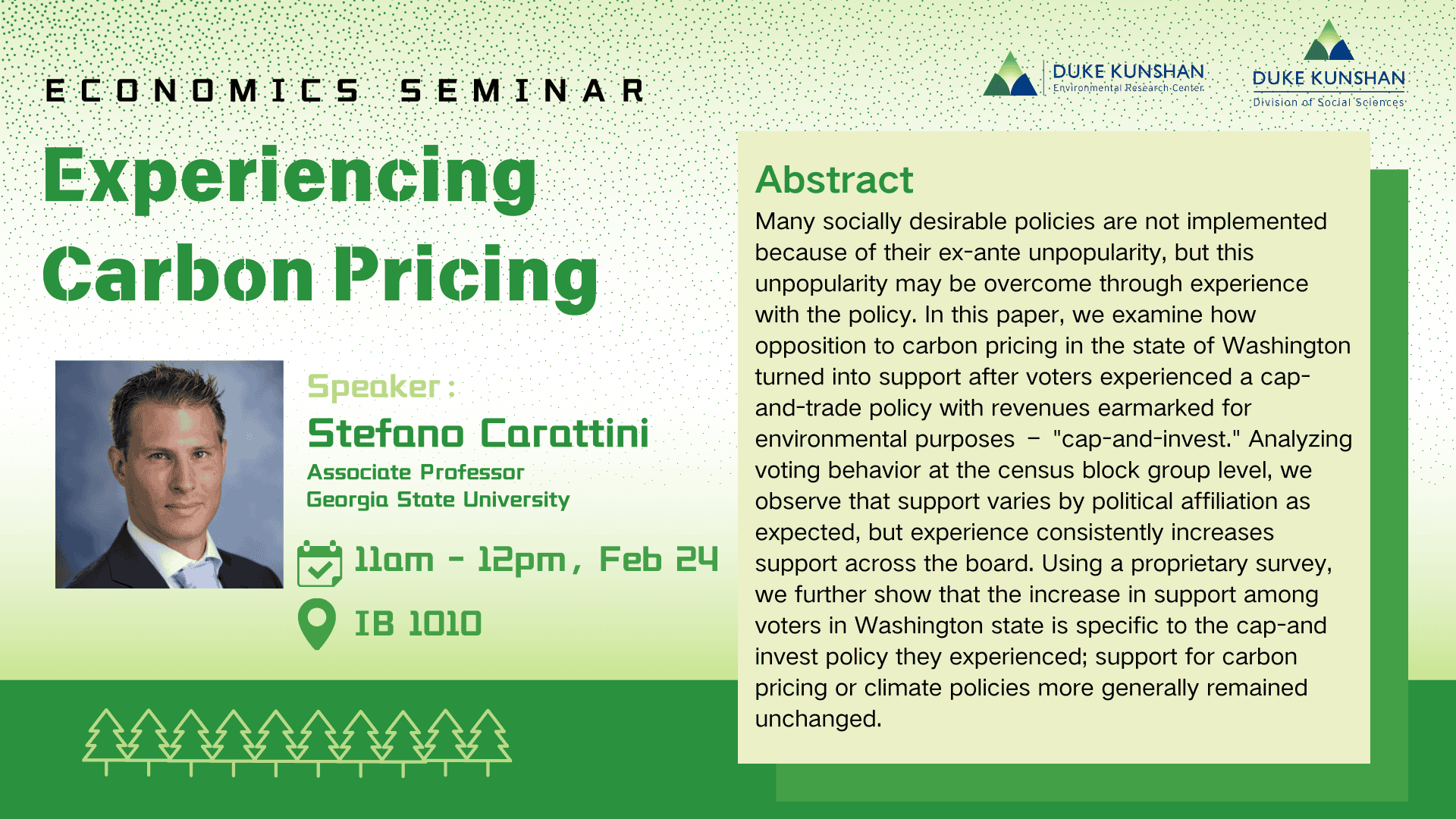
Time: 11AM – 12PM, Tuesday, February 24
Venue: IB 1010
Speaker: Stefano Carattini, Associate Professor in the Department of Economics at Georgia State University
Speaker’s bio: Stefano Carattini is an Associate Professor in Economics in the Andrew Young School of Policy Studies at Georgia State University.
He is an environmental economist with broader interests in behavioral economics, public economics, and political economy. His research combines policy evaluation to examine how policies work, with analyses of their political economy, including questions of asset stranding and transition risk. He has also been working on cooperative (pro-social) behavior and the diffusion of green behaviors, practices, and technologies.
He has published in both general science journals, such as Nature and Science, as well as leading journals in economics, such as the Review of Economics and Statistics, the Journal of Environmental Economics and Management, and the Journal of Economic Behavior and Organization. Since 2015, he has raised about $2 million in external funding.
He is one of the recipients of the Heinz König Young Scholar Award, delivered by the Mannheim Centre for European Economic Research (ZEW). Prior to joining Georgia State, he was an Associate Research Scientist at Yale University, where he was also a Lecturer in the School of Public Health. He obtained a PhD in Economics from the University of Barcelona and an MSc in Economics from the University of Lausanne. He also holds a BA in Socio-economics from the University of Geneva.
Abstract: Many socially desirable policies are not implemented because of their ex-ante unpopularity, but this unpopularity may be overcome through experience with the policy. In this paper, we examine how opposition to carbon pricing in the state of Washington turned into support after voters experienced a cap-and-trade policy with revenues earmarked for environmental purposes – “cap-and-invest.” Analyzing voting behavior at the census block group level, we observe that support varies by political affiliation as expected, but experience consistently increases support across the board. Using a proprietary survey, we further show that the increase in support among voters in Washington state is specific to the cap-and invest policy they experienced; support for carbon pricing or climate policies more generally remained unchanged.