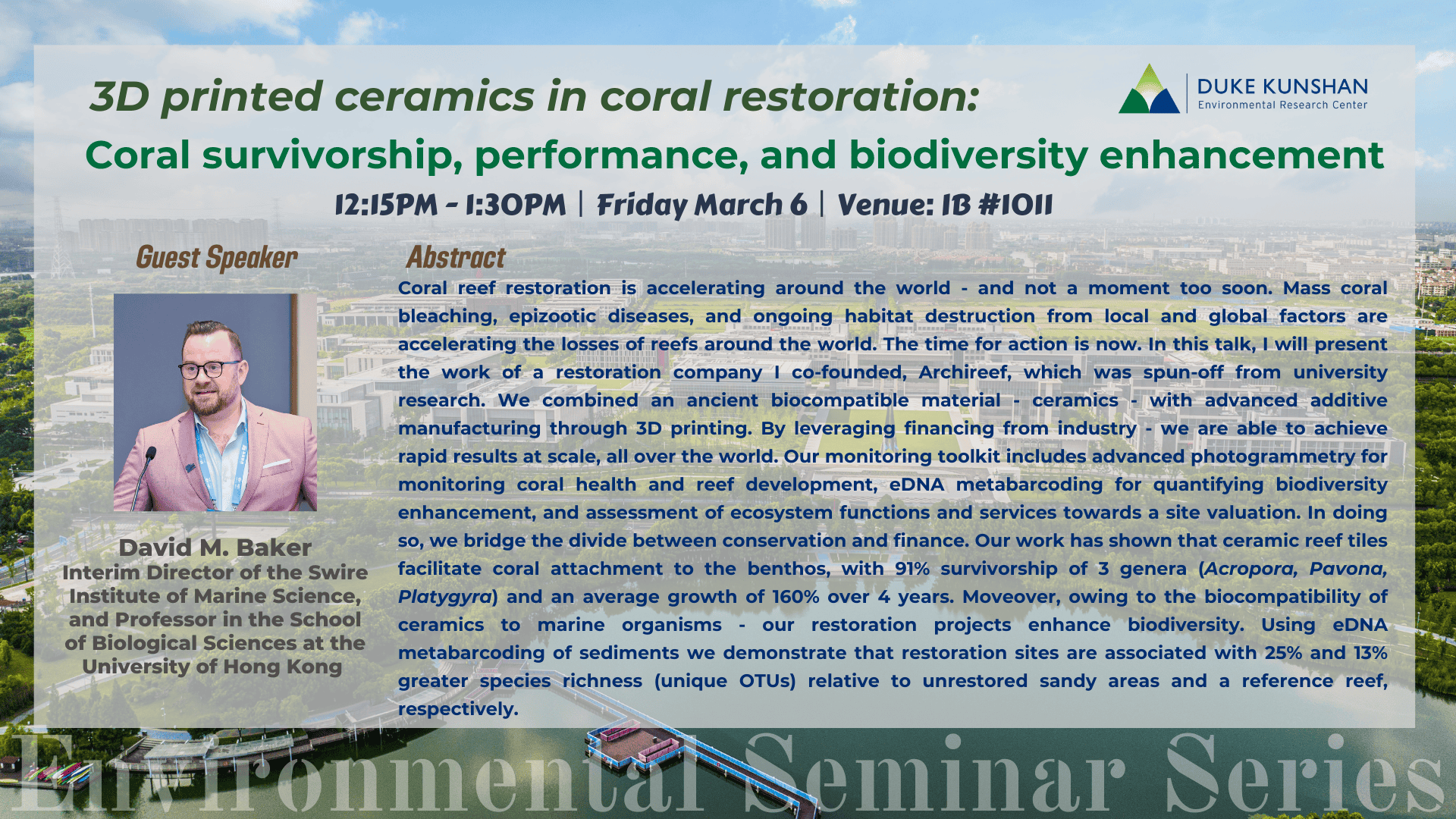
Time: 12:15PM – 1:30 PM, Friday, March 6
Venue: IB 1011
Speaker: David M. Baker
Speaker’s bio: David M. Baker is the Interim Director of the Swire Institute of Marine Science, and Professor in the School of Biological Sciences at the University of Hong Kong. Following his Ph.D. in Ecology and Evolutionary Biology from Cornell, he was a postdoctoral fellow at the prestigious Carnegie and Smithsonian Institutions. His academic career has seen impact across disciplines – from environment (marine pollution, chemical oceanography) to organism/cell (eco-physiology, symbiosis) – with >100 peer-reviewed publications. Dr. Baker’s service extends beyond the university. He serves as associate editor for Limnology & Oceanography. He has been a consultant to various local and international government agencies, and has executed and managed projects in coral reef restoration around the world. He was the Founding Director of the MarineGEO-Hong Kong project – which has raised more than US$2M in government funding to establish a new baseline for local biodiversity, and how that relates to ecosystem functioning and services. As a biogeochemist by training, Dr. Baker is the Director of the Stable Isotope Mass Spectrometry Laboratory at HKU – the only open-access facility of its kind in all of Asia.
Abstract: Coral reef restoration is accelerating around the world – and not a moment too soon. Mass coral bleaching, epizootic diseases, and ongoing habitat destruction from local and global factors are accelerating the losses of reefs around the world. The time for action is now. In this talk, I will present the work of a restoration company I co-founded, Archireef, which was spun-off from university research. We combined an ancient biocompatible material – ceramics – with advanced additive manufacturing through 3D printing. By leveraging financing from industry – we are able to achieve rapid results at scale, all over the world. Our monitoring toolkit includes advanced photogrammetry for monitoring coral health and reef development, eDNA metabarcoding for quantifying biodiversity enhancement, and assessment of ecosystem functions and services towards a site valuation. In doing so, we bridge the divide between conservation and finance. Our work has shown that ceramic reef tiles facilitate coral attachment to the benthos, with 91% survivorship of 3 genera (Acropora, Pavona, Platygyra) and an average growth of 160% over 4 years. Moveover, owing to the biocompatibility of ceramics to marine organisms – our restoration projects enhance biodiversity. Using eDNA metabarcoding of sediments we demonstrate that restoration sites are associated with 25% and 13% greater species richness (unique OTUs) relative to unrestored sandy areas and a reference reef, respectively.
This event is hosted by the Environmental Research Center