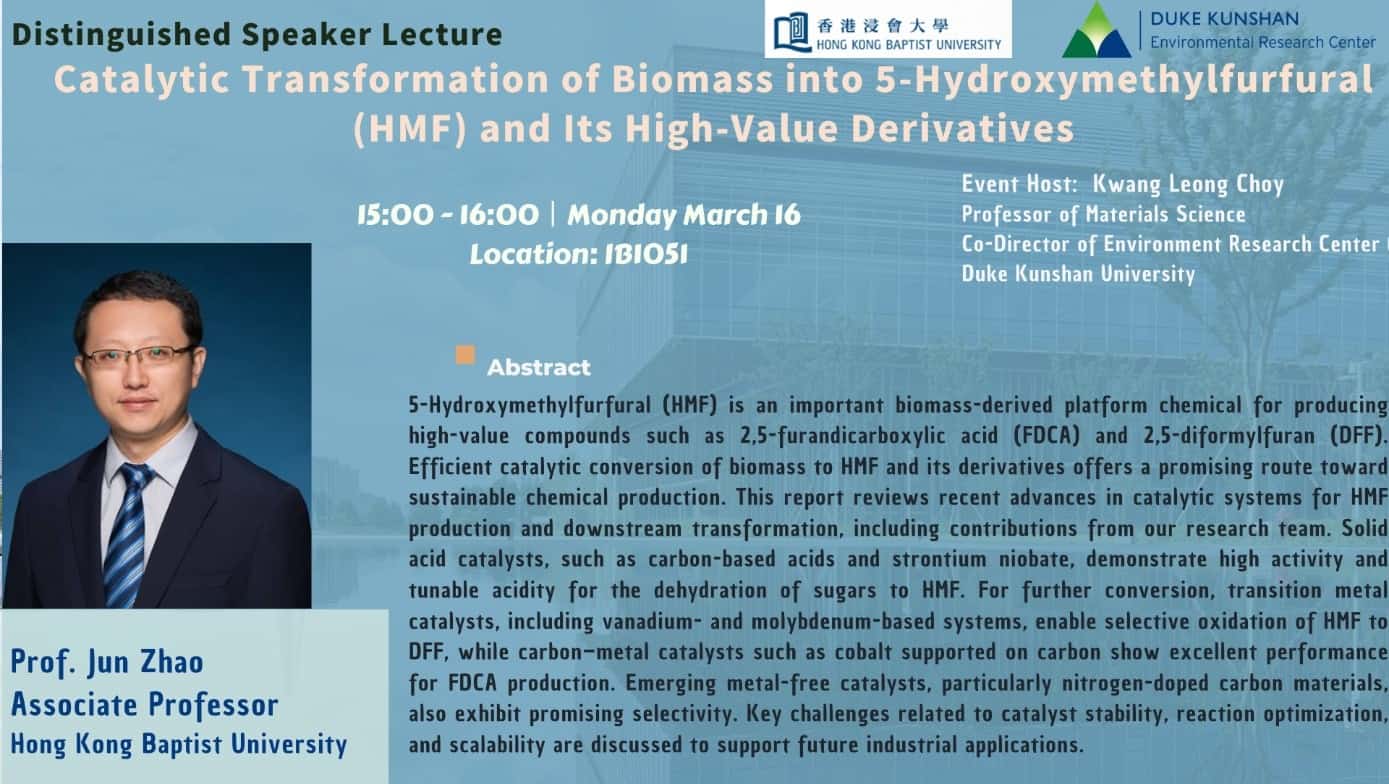
Time: 3:00PM – 4:00PM, Monday, March 16, 2026
Venue: IB 1051
Speaker: Prof. Jun Zhao
Speaker’s bio: Prof. Jun Zhao is an Associate Professor in the Department of Biology at the Faculty of Science, Hong Kong Baptist University. He also serves as the Director of the Applied Research Centre for Pearl River Delta Environment. Dr. Zhao earned his Ph.D. in Chemical and Biomolecular Engineering from Nanyang Technological University in Singapore, where he subsequently worked as a Research Fellow at the Energy Research Institute. In 2019, he joined Hong Kong Baptist University, where he leads the Biomass and Bioenergy Laboratory. Prof. Zhao’s research focuses on green catalysis and green chemical engineering, with a particular emphasis on the valorization of solid waste, energy conversion, and utilization technologies. He has developed highly efficient catalytic systems for biomass valorization and plastic waste upcycling, significantly boosting product yields while lowering reaction temperatures and energy consumption. His work enables practical, scalable routes to convert municipal solid waste into clean fuels, hydrogen, and high-value chemicals. He has published over 150 papers in leading international journals in the fields of chemical engineering and energy such as like Energy & Environmental Science, Advanced Materials, Chemical Engineering Journal, Small, etc. Prof. Zhao is a member of several prestigious societies, including the Chinese Chemical Society, the Chinese Society for Environmental Sciences, and the American Chemical Society. Prof. Zhao also serves on the editorial boards of several prominent journals such as Energy, Ecology and Environment, Environmental Technology, Waste Disposal and Sustainable Energy etc. He has been listed among the World’s Top 2% Scientists in 2023, 2024, and 2025, and was elected Vebleo Fellow in 2025.
Abstract: 5-Hydroxymethylfurfural (HMF) is a versatile platform compound derived from biomass that has garnered significant attention due to its potential for producing high-value chemicals such as 2,5-furandicarboxylic acid (FDCA) and 2,5-diformylfuran (DFF). The efficient catalytic conversion of biomass to HMF and its derivatives represents a promising strategy for sustainable chemical production. This report focuses on recent advances in this field, including the work conducted by our research team. In the production of HMF, solid acid catalysts, such as carbon-based solid acids and strontium niobate, play a pivotal role, demonstrating high activity in the dehydration of sugars. This report highlights the tunable acidity and reusability of these catalysts, as well as the optimization strategies employed to improve HMF yield. For the downstream conversion of HMF, we systematically discuss selective oxidation pathways. Transition metal catalysts, such as vanadium- and molybdenum-based systems, efficiently convert HMF to DFF under mild conditions, while carbon–metal hybrid catalysts, such as cobalt supported on carbon, show excellent performance in the oxidation of HMF to FDCA. The carbon support enhances both the structural stability and catalytic activity of the metal active sites. In addition, emerging metal-free catalytic systems, particularly nitrogen-doped carbon catalysts, exhibit promising selectivity in HMF oxidation, presenting a potential alternative to conventional metal catalysts. This report also reviews recent developments in these catalytic systems, analyzing their selectivity, stability, and scalability, while addressing the challenges associated with catalyst longevity, reaction optimization, and economic viability. Overall, the report provides a comprehensive overview of biomass-based HMF catalytic conversion strategies, emphasizing the contributions of our research team and their potential for commercial application.