
Start

2026-02-06
02:30 PM

End

2026-02-06
03:30 PM

Location

WDR 1003

Type

Share

Event details

Time: 2:30PM – 3:30PM, Friday February 6, 2026

Venue: WDR 1003

Speaker: Xiaomeng Cui, Professor at the Institute for Economic and Social Research (IESR), Jinan University

Speaker’s bio: Xiaomeng Cui is a Professor at the Institute for Economic and Social Research (IESR), Jinan University, Guangzhou, China. He is currently an Associate Editor of American Journal of Agricultural Economics, and serves on the Editorial Council of Journal of Environmental Economics and Management. His research fields include development, environmental, and agricultural economics. His recent papers have been published in Journal of Econometrics, Journal of Development Economics, Journal of Urban Economics, Journal of the Association of Environmental and Resource Economists, Journal of Environmental Economics and Management, and American Journal of Agricultural Economics.
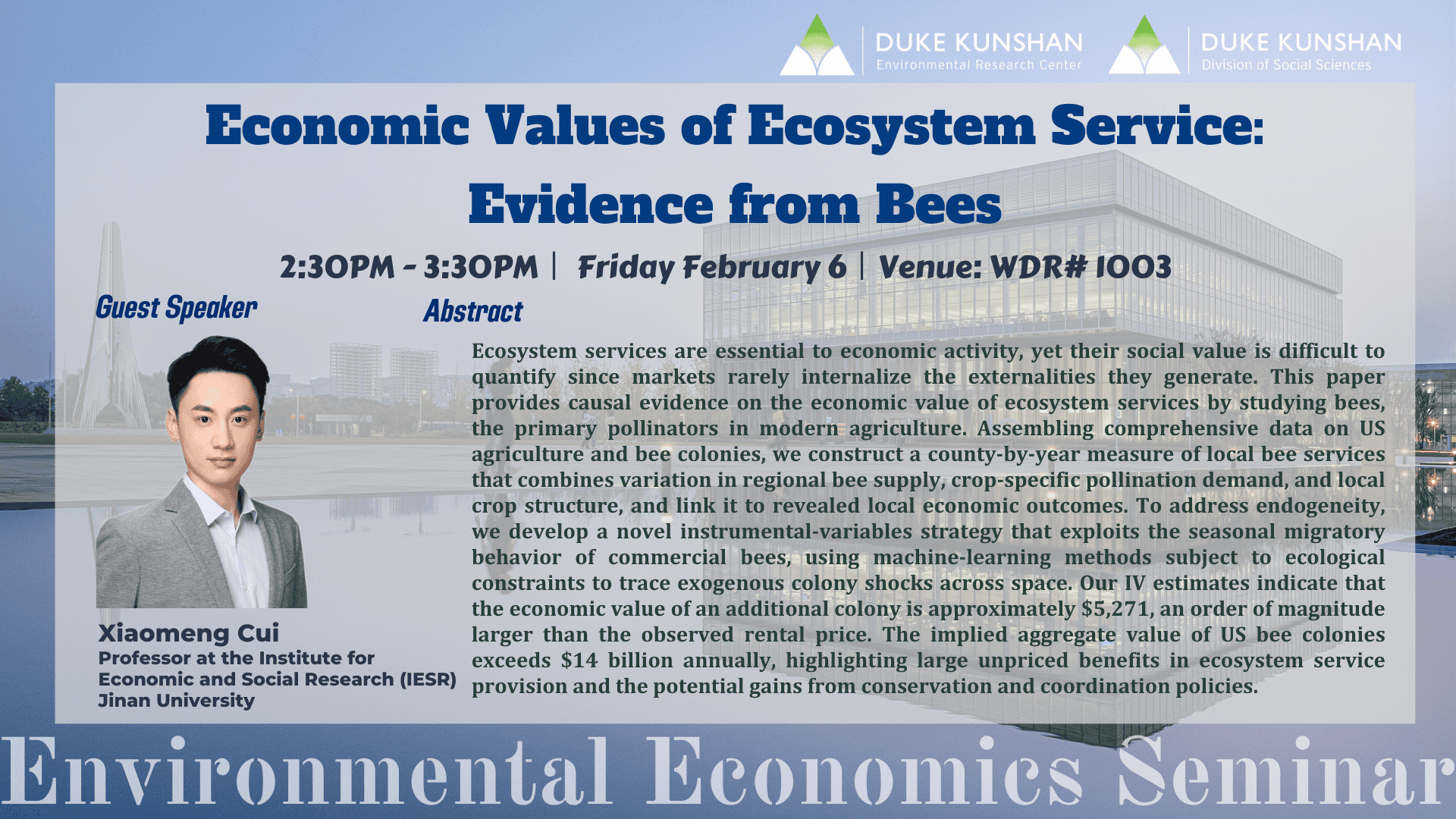
Abstract: Ecosystem services are essential to economic activity, yet their social value is difficult to quantify since markets rarely internalize the externalities they generate. This paper provides causal evidence on the economic value of ecosystem services by studying bees, the primary pollinators in modern agriculture. Assembling comprehensive data on US agriculture and bee colonies, we construct a county-by-year measure of local bee services that combines variation in regional bee supply, crop-specific pollination demand, and local crop structure, and link it to revealed local economic outcomes. To address endogeneity, we develop a novel instrumental-variables strategy that exploits the seasonal migratory behavior of commercial bees, using machine-learning methods subject to ecological constraints to trace exogenous colony shocks across space. Our IV estimates indicate that the economic value of an additional colony is approximately $5,271, an order of magnitude larger than the observed rental price. The implied aggregate value of US bee colonies exceeds $14 billion annually, highlighting large unpriced benefits in ecosystem service provision and the potential gains from conservation and coordination policies.