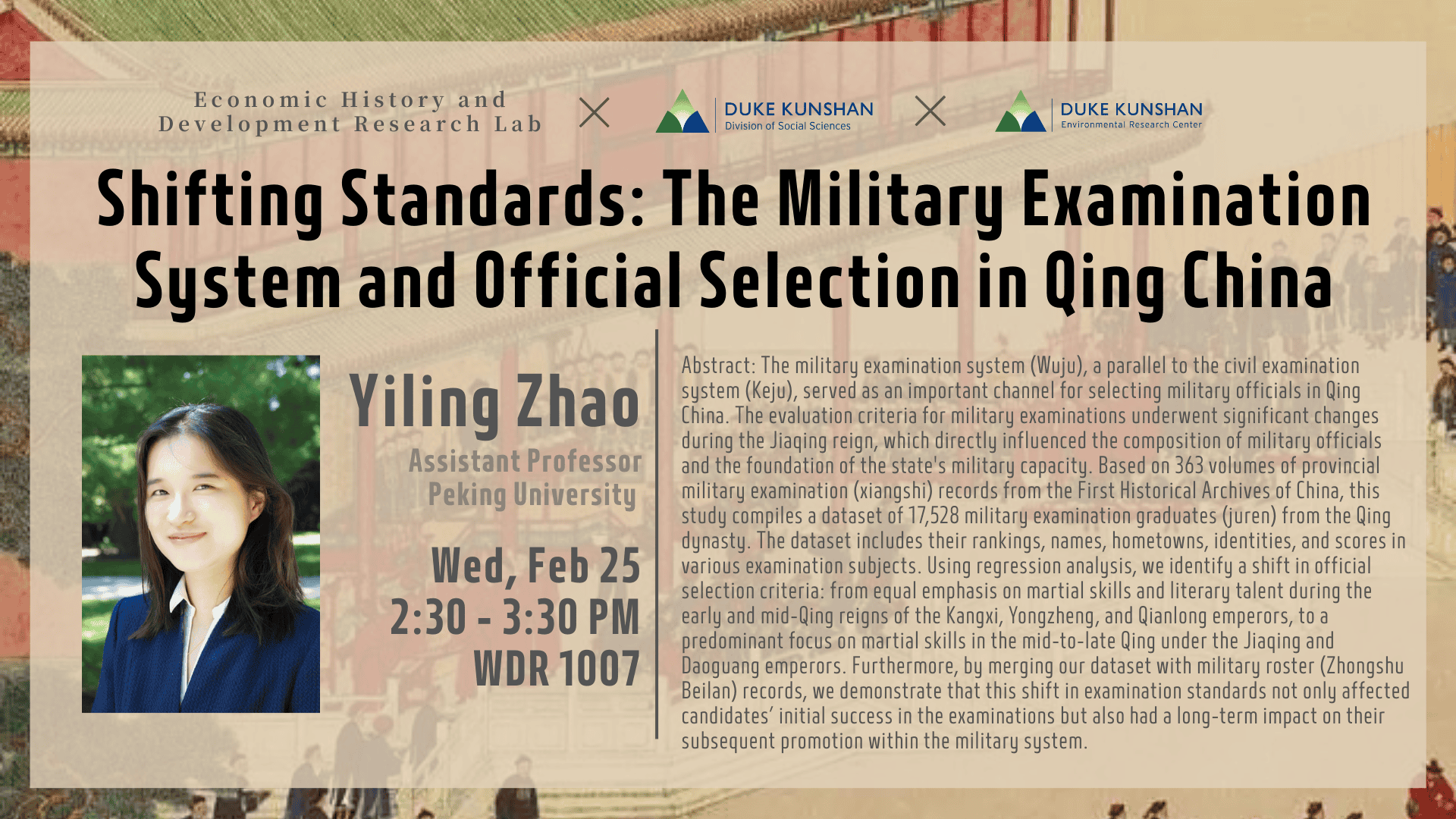
Time: 2:30PM – 3:30PM, Wednesday, Feburary 25
Venue: TBD
Speaker: Yiling Zhao, Assistant Professor at the School of Economics, Peking University
Speaker’s bio: Yiling Zhao is an Assistant Professor at the School of Economics, Peking University. Her research interests include culture, religion, and their roles in human capital accumulation. Her research has been published in the Journal of Economic History and Explorations in Economic History.
Abstract: The military examination system (Wuju), a parallel to the civil examination system (Keju), served as an important channel for selecting military officials in Qing China. The evaluation criteria for military examinations underwent significant changes during the Jiaqing reign, which directly influenced the composition of military officials and the foundation of the state’s military capacity. Based on 363 volumes of provincial military examination (xiangshi) records from the First Historical Archives of China, this study compiles a dataset of 17,528 military examination graduates (juren) from the Qing dynasty. The dataset includes their rankings, names, hometowns, identities, and scores in various examination subjects. Using regression analysis, we identify a shift in official selection criteria: from equal emphasis on martial skills and literary talent during the early and mid-Qing reigns of the Kangxi, Yongzheng, and Qianlong emperors, to a predominant focus on martial skills in the mid-to-late Qing under the Jiaqing and Daoguang emperors. Furthermore, by merging our dataset with military roster (Zhongshu Beilan) records, we demonstrate that this shift in examination standards not only affected candidates’ initial success in the examinations but also had a long-term impact on their subsequent promotion within the military system.
This event is co-sponsored by the Center for the Study of Contemporary China, and the Environmental Research Center